

For years I told salon clients the same thing when they'd sit down in my chair looking tired around the eyes and heavy through the jaw: that's not aging, that's fluid. Overnight, especially once you're past 40, your body doesn't move lymph and fluid the way it used to while you sleep. It pools under the eyes, along the jawline, sometimes right across the cheeks, and you wake up looking like you argued with a pillow and lost. The good news is that puffiness like that is usually the easiest thing on your face to fix, and you don't need a dermatologist or a device that costs more than your electric bill.
What I use, and what I've handed to more clients than I can count over 25 years behind a salon chair, is a gua sha stone. Not a fancy one, either. The BAIMEI IcyMe Rose Quartz Roller and Gua Sha Set is budget-friendly and it's the exact routine I'm about to walk you through, step by step, the same way I'd have taught it to you in my chair on a Tuesday morning.
This routine works whether your puffiness comes from a salty dinner the night before, a bad night's sleep, seasonal allergies, or just the general fluid retention that shows up more often once you're past 40. It won't touch fine lines or sun damage, that's not what gua sha is for, but for the specific problem of a swollen, tired looking face first thing in the morning, five minutes with the right tool and the right technique is genuinely enough.
Wake Up Puffy? Here's the Nine Dollar Tool I Hand Every Client
The BAIMEI IcyMe Rose Quartz Roller and Gua Sha Set is what I use every morning to clear puffiness before I even start my coffee. Check today's price while it's still budget-friendly.
Amazon Check Today's Price on Amazon →Step 1: Prep Your Skin and Chill the Stone
Gua sha only works well when the stone can actually glide, so start with clean skin and a thin layer of facial oil or a lightweight serum. Skip a thick, heavy cream underneath. A rich moisturizer will make the stone slip too fast for it to catch the muscle underneath, and catching the muscle is the whole point.
I keep the flat gua sha stone from my BAIMEI set in the refrigerator door, right next to the eggs, so it's cold every single morning without me having to think about it. Cold rose quartz constricts the small blood vessels near the surface of your skin, which is part of why puffiness eases so quickly once you get moving. If you forget to chill it overnight, even five minutes in the freezer before you start helps.
One thing I tell every client before we even pick up the stone: this only takes five minutes, start to finish. Don't treat it like a spa ritual you need a free hour for, or you'll talk yourself out of doing it most mornings, and consistency is what actually makes this work.
It helps to know the two pieces before you start. The BAIMEI set gives you a double ended roller, a larger wheel for cheeks and jaw and a smaller one sized for the under eye area, plus a separate flat, curved gua sha stone shaped to hug your jawline and neck. The roller is gentler and better for a light daily pass. The flat stone lets you apply real, targeted pressure, and it's the piece doing most of the depuffing work in the steps below.
Step 2: Start at the Neck to Open the Drainage Path
This is the step almost everyone skips, and it's the one that matters most. Fluid needs somewhere to go, and it drains down through lymph nodes near your collarbone and the sides of your neck. If those pathways are congested, all the jaw and cheek work you do afterward just moves fluid around without anywhere for it to actually drain.
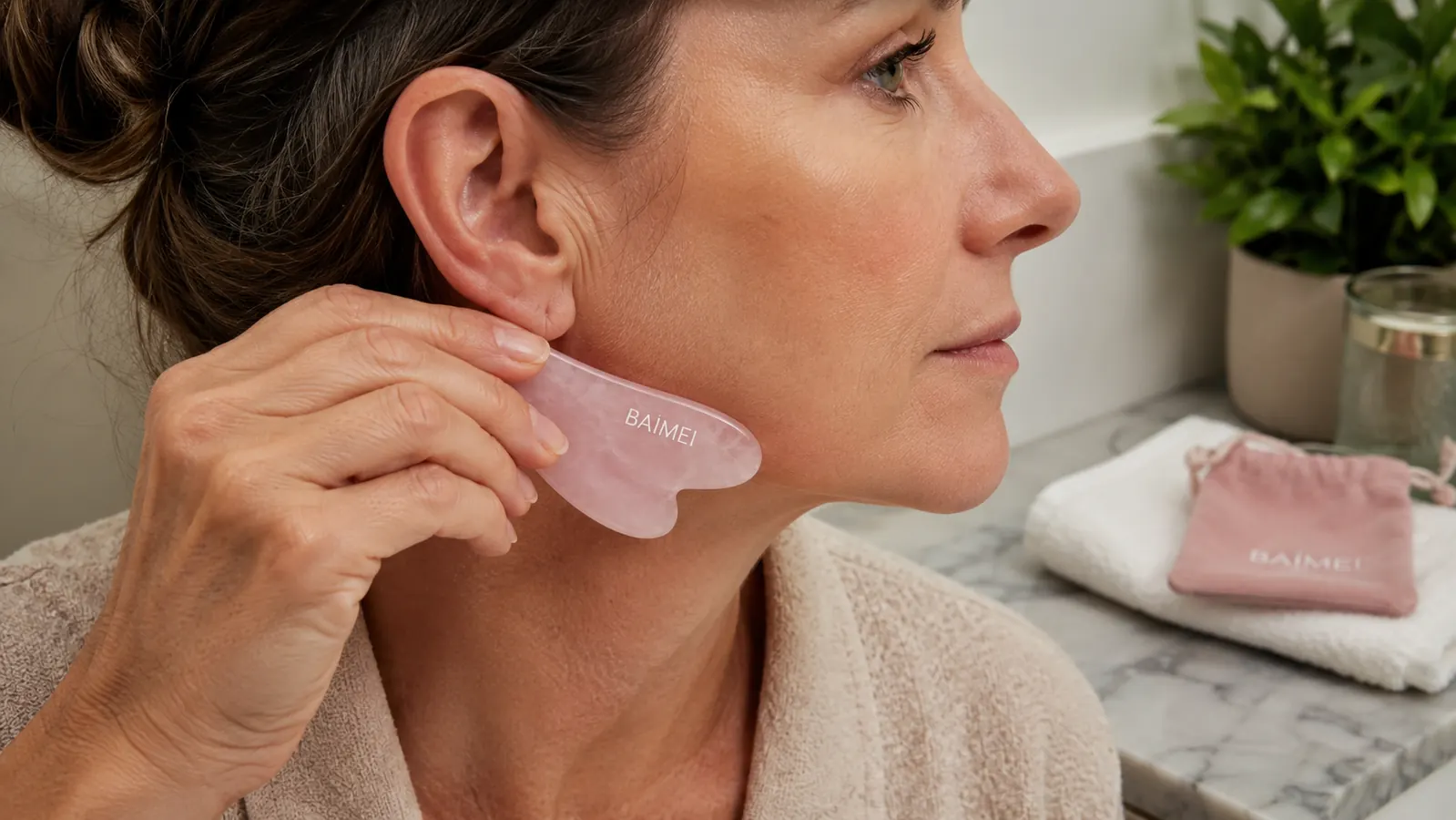
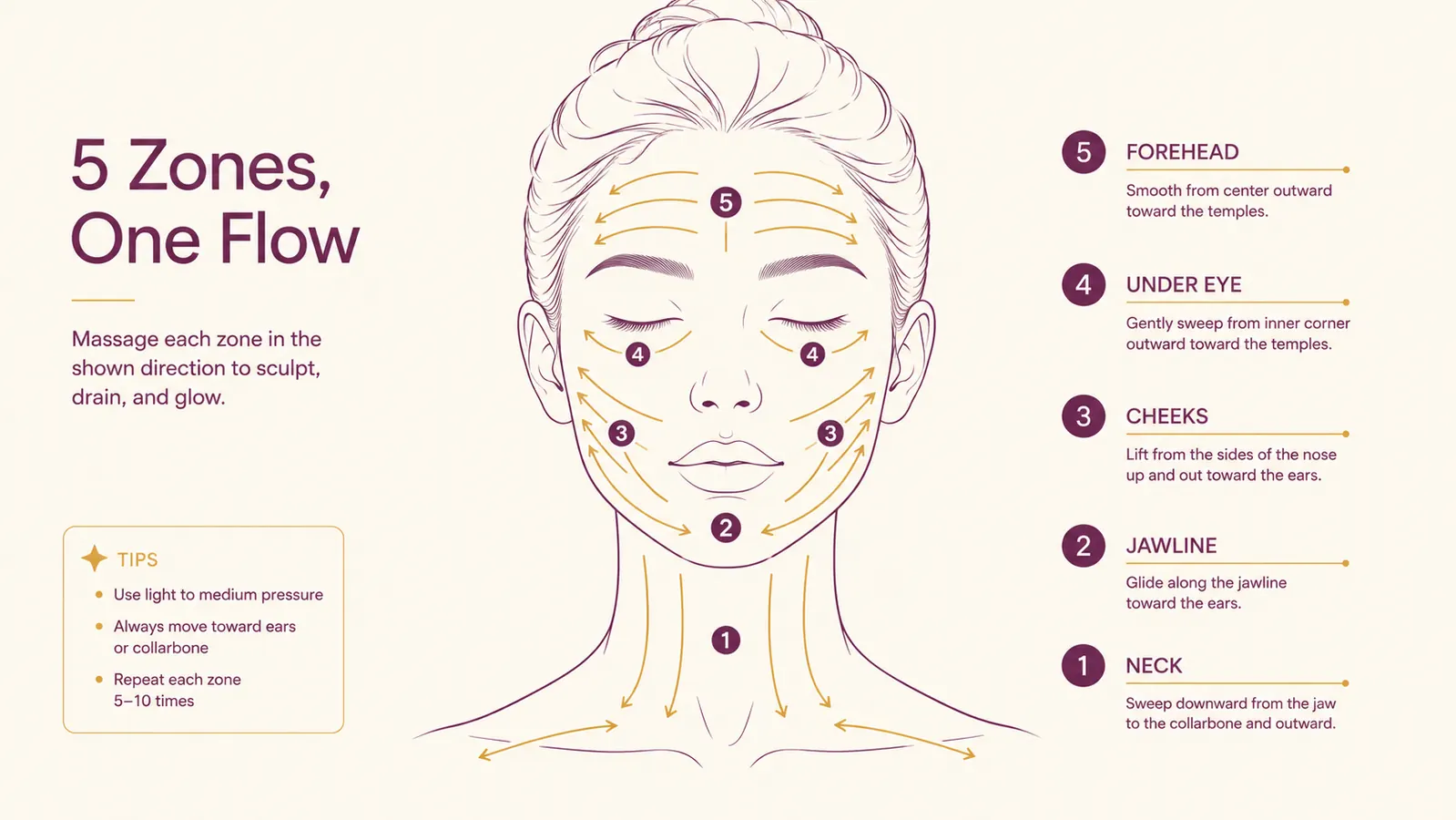
Hold the flat edge of the gua sha stone against the side of your neck, just below your ear, and sweep downward toward your collarbone with light, even pressure. Do this four or five times on each side. You're not trying to feel anything dramatic here, just gently clearing the path before you start on your face.
I learned this the hard way in my own routine. For the first couple weeks I skipped straight to my jaw and cheeks because it felt more satisfying, and I genuinely couldn't figure out why my results were so inconsistent. Once I added thirty seconds of neck work first, everything else started working noticeably better within days.
Step 3: Sweep the Jawline From Chin to Ear
This is where most of the morning swelling I see settles in, right along the jaw and under the chin, and it's also where gua sha does its most visible work. Angle the curved edge of the stone against your jawbone, roughly a 15 degree angle rather than flat against the skin, and stroke from the center of your chin outward toward your ear.
Use firm pressure here, firmer than you'd think comfortable at first, something close to a confident handshake rather than a light pat. Repeat five to seven strokes per side. Firmer pressure on the jaw is safe because the bone underneath gives you something solid to press against, unlike the delicate skin under your eyes.
If your jaw tends to look softer and more swollen by mid-morning no matter what you do, this step alone, done consistently, is usually what turns that around. I've watched it work on more clients than I can count, myself included.

Step 4: Move to the Cheeks, Then the Delicate Under Eye Area
For your cheeks, use the same flat stone edge or the larger side of the roller if you're switching tools, and stroke outward from the sides of your nose toward your ears, angling slightly upward. Three or four passes per side is plenty. You're aiming to move fluid up and out, not to press hard into the tissue.
Under eye puffiness needs the gentlest touch of the whole routine, so this is where I tell clients to ease way off the pressure. Use the smaller roller ball from the BAIMEI set, not the flat stone edge, and roll lightly from the inner corner near your nose outward toward your temple, following the bone just under your eye rather than the soft tissue itself. Two or three light passes is enough. This skin is thinner and more fragile than anywhere else on your face, and pressing hard here can actually stretch it over time.
If you have rosacea, visible broken capillaries, or skin that flushes easily, this is the step to be most careful with. Lighten your pressure everywhere, not just under the eyes, and if anything looks more red than usual afterward, ease up further the next morning.
Step 5: Finish at the Forehead and Temples
Last, work your forehead in horizontal strokes from the center out toward each temple, then a few gentle strokes down each temple toward your ear to help that fluid finish its drain. This step does less for visible puffiness and more for a general sense of tension release, which is a nice place to end a five minute routine before you move on with your morning.
Once you're done, rinse the stone, dry it, and tuck it back into the small velvet pouch that comes with the BAIMEI set rather than leaving it loose in a drawer. Rose quartz will chip against a hard counter or get scratched by a hairbrush or bobby pins sitting next to it, and a chip near the edge can turn a smooth stroke into an uncomfortable one.
Mistakes That Undo the Effort
The biggest mistake I see, and the one I made myself for the first couple weeks, is scrubbing in random circles instead of following a direction. Gua sha isn't a scrubbing motion. Every stroke needs to move toward a lymph node, meaning up and out toward your ears, and down toward your collarbone. Circles feel soothing but they don't clear anything, they just push fluid back and forth in place.
The second mistake is pressure that's either too light to do anything or too heavy in the wrong spot. A light pat across your jaw won't move enough fluid to matter, and firm pressure under your eyes can drag and stretch skin that's too delicate for it. The pressure should change depending on where you are on your face, firm over bone, feather light over the thin skin near your eyes.
The third mistake is skipping mornings and expecting the effect to hold anyway. This isn't a one time fix, it's closer to brushing your teeth. Skip it for a few days and the puffiness you were managing comes right back, because the fluid retention that caused it in the first place never actually went away. It just wasn't visible while you kept clearing it every morning.
What Else Helps
Gua sha does real, repeatable work, but it's not fighting alone. A few things I tell clients to pair with it, if morning puffiness is a regular problem rather than an occasional one. Try sleeping with an extra pillow or a slight incline so fluid doesn't pool as heavily overnight in the first place. Watch your sodium the evening before, since a salty dinner out is one of the most reliable ways to wake up swollen. Drink water before bed rather than right before you fall asleep, so you're not retaining as much overnight. And if allergies are part of your picture, that puffiness may need an antihistamine working alongside your stone, not instead of it. None of that replaces the five minutes with the gua sha stone, it just means those five minutes have less work to do.
As for how fast you'll see it working, most people notice something within the first week, though the full effect usually shows up by week two or three, once your technique settles in and you stop rushing through it. Don't judge the routine off one groggy Monday morning. Give it ten straight days before you decide whether it's doing anything for your face, the same way I'd tell a client to commit to a new product for at least that long before writing it off.
You don't need to erase forty years of gravity before breakfast. You just need to get the fluid moving before you look in the mirror, and five minutes with the right tool does exactly that.
Keep it simple, keep it in order, and keep showing up for it. That's really the whole lesson I gave clients in my chair for 25 years, and it's the same one I still follow at my own bathroom sink every single morning.
Same Routine I Taught in My Salon Chair, Now in a Nine Dollar Kit
The BAIMEI IcyMe Rose Quartz Roller and Gua Sha Set has both tools you need for this exact routine, the roller and the flat stone, in one small kit. Check today's price on Amazon and try it tomorrow morning.
Amazon Check Today's Price on Amazon →